Telti-Kuruk: The Autochthonous Grape of the Black Sea Coast
Among the thousands of grape varieties known to modern ampelography, only a handful can call the Northern Black Sea coast their homeland. Telti-Kuruk is one of them. This white wine grape has grown in southern Ukraine for more than five centuries. Its name has Turkic roots, its vines survived phylloxera and Soviet-era uprooting campaigns, and its wines are only now being discovered by enthusiasts on both sides of the Atlantic. We grow Telti-Kuruk in our vineyard and are convinced that this variety is one of Ukrainian winemaking’s most compelling stories.
What makes this little-known autochthonous grape so remarkable? Why did the international Slow Food organisation include it in its catalogue of endangered foods? And what does a wine taste like when it carries the genetic code of the Black Sea steppe?
History of the variety: from the Ottoman Empire to the present
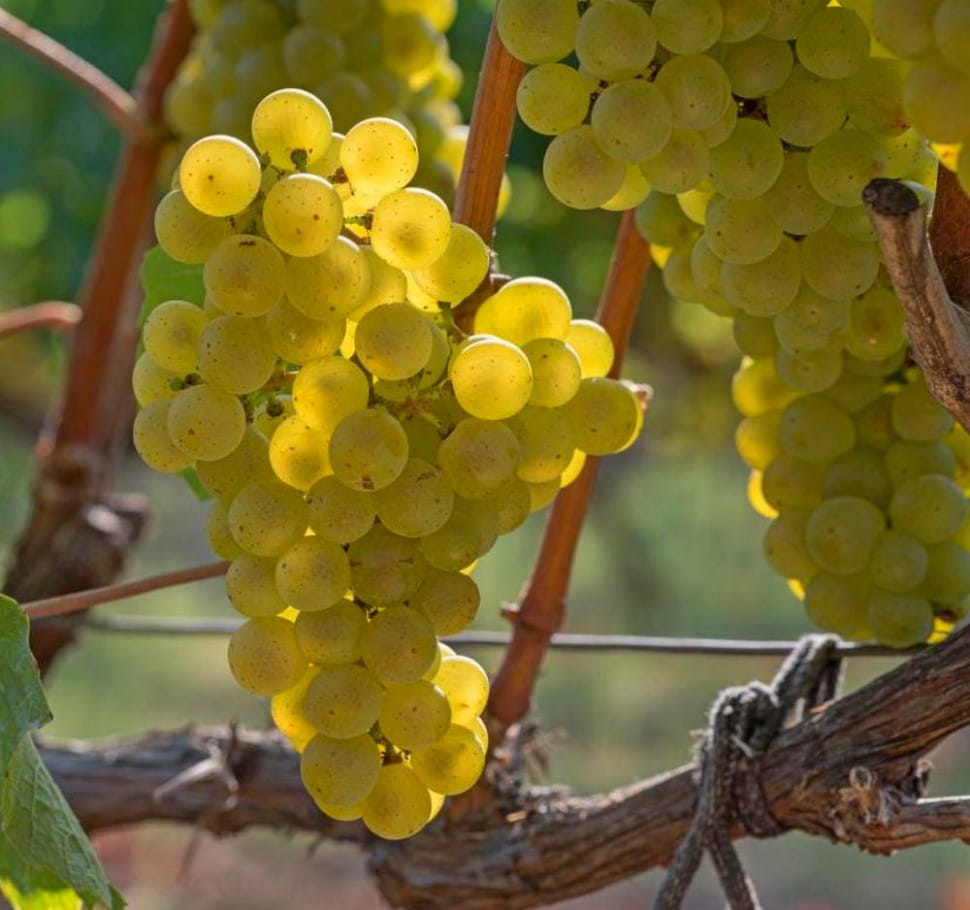
The earliest mentions of Telti-Kuruk date to the 16th century, when the territory of what is now southern Ukraine was under Ottoman rule. In the area around Akkerman — present-day Bilhorod-Dnistrovskyi — various grape varieties were cultivated, Telti-Kuruk among them. The name derives from the Turkish tilki kuyruğu, meaning “fox tail.” The bunches of Telti-Kuruk do indeed resemble a fox’s tail: elongated, cylindrical-conical, moderately compact.
Intriguingly, despite its Turkic name, the variety’s genetic roots likely reach much further back — to the South Caucasus, possibly Armenia. Xeniya Volosnikova, writing for JancisRobinson.com, notes that Telti-Kuruk “likely emerged during the early domestication of vines, though its exact parentage remains unknown.” The multiple spellings of its name — Telti Kourouk, Telti Kyryk, Tilky Rairuk — testify to a long history of the name migrating between languages and dialects. The variety has no genetic connection to Italy’s Coda di Volpe, though both names translate as “fox tail” — the coincidence is explained by the similar shape of the grape clusters.
For centuries, Telti-Kuruk remained a local variety of the sandy soils along the Black Sea coast. In the late 19th century, when the phylloxera epidemic destroyed between two-thirds and nine-tenths of all European vineyards, Telti-Kuruk survived. In France alone, wine production fell from 84.5 million hectolitres in 1875 to just 23.4 million by 1889. The sandy soils on which Telti-Kuruk grew served as a natural barrier against the root louse — the insect simply could not reach the roots through sand. This is the same property of sandy soils that saved the vineyards of Colares in Portugal and certain plots in Galicia from phylloxera.
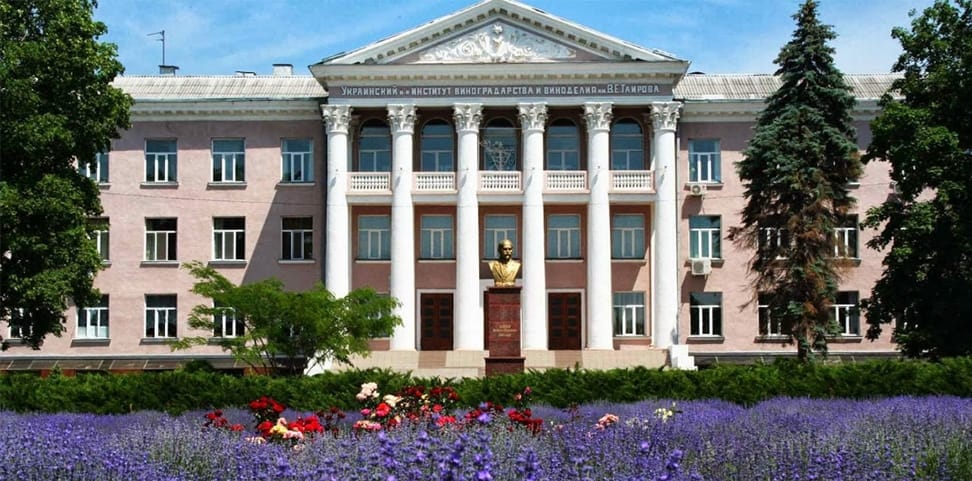
The second trial came in the 20th century. The Soviet anti-alcohol campaign of 1985–1987 led to the mass uprooting of vineyards across Ukraine. Telti-Kuruk, already scarce, found itself on the brink of extinction. Only thanks to the efforts of individual viticulturists and research institutions — notably the Tairov Institute of Viticulture and Winemaking, which has been conducting clonal selection of this variety since 1986 — was Telti-Kuruk preserved.
Today, the total area planted with Telti-Kuruk in Ukraine amounts to a few dozen hectares. The largest and oldest own-rooted plantings belong to the Shabo winery in the Odesa region — over 43 hectares, with vines cultivated since 1972. As of 2024, several wineries produce wine from Telti-Kuruk: Shabo, Ofiussa in Bilhorod-Dnistrovskyi, Drunk Master in Kharkiv, and ourselves at Beykush in the Mykolaiv region.
Ampelographic profile: identifying Telti-Kuruk
Telti-Kuruk is a white wine grape of the species Vitis vinifera, belonging to the Black Sea basin group of varieties. According to the 1986 reference book Grape Varieties, the period from bud break to harvest maturity in the Odesa region is 155–157 days with an accumulated temperature sum of 3,000°C. This makes Telti-Kuruk a late-ripening variety — the average harvest date falls at the end of September.
The leaf is medium-sized, round, slightly lobed with three or five lobes. The lower surface is covered with dense pubescence. The flower is bisexual, ensuring self-pollination. The annual shoot is pinkish-yellow-brown with a glaucous bloom and reddish-brown nodes. Autumn leaf coloration is yellow.
The bunches are the variety’s calling card. Medium-sized (approximately 16 cm long and 9 cm wide), cylindrical-conical in shape, sometimes cylindrical, moderately compact or compact. Bunch weight ranges from 90 to 134 grams. It is precisely the elongated shape of the bunch, resembling a fox’s tail, that gave the variety its name.
The berries are small to medium-sized, slightly oval, yellowish-green with a thick waxy bloom. The skin is thin but firm. The flesh is juicy and delicate. According to the Wines of Ukraine portal, wines from Telti-Kuruk display a distinctly mineral character with floral and fruit notes — primarily white acacia and ripe quince. On the palate, the wine is full-bodied, with minerality reflecting the terroir and a fresh, slightly bitter finish.
One of Telti-Kuruk’s most important agronomic advantages is its resilience. The variety shows good resistance to downy mildew, powdery mildew, and drought. Its sturdy trunk withstands the fierce winds of the Black Sea steppe — an adaptation developed over centuries. Some own-rooted Telti-Kuruk vines are up to 50 years old and produce exceptional wines. Naturally low yields limited its popularity among volume-focused producers but made it a prized find for quality-driven wineries.
Telti-Kuruk in the Slow Food catalogue: global recognition
In the 2010s, Telti-Kuruk was added to the Ark of Taste — the global catalogue of the Slow Food Foundation for Biodiversity that documents food products at risk of extinction. The nomination was submitted by Alla Podolskaya. The catalogue contains over 3,500 products from more than 150 countries, each meeting strict criteria: the product must be endemic to a specific territory, produced in limited quantities, and face a genuine risk of disappearing.
Inclusion in the Ark of Taste is not a marketing award — it is an alarm signal. Slow Food states plainly: if action is not taken now, this product may not survive another generation. For Telti-Kuruk, the risk factors are the small area of plantings, the limited number of producers, and the ongoing war in Ukraine.
At the same time, the Ark of Taste serves as a platform for revival. By documenting rare products, Slow Food builds communities of producers, chefs, and conscious consumers around them. For Ukrainian autochthonous varieties, this means international visibility and access to markets that value biodiversity and local identity.
The preservation of autochthonous grape varieties is a global challenge. According to Wine Spectator, hundreds of indigenous grape varieties worldwide face extinction. The industrialisation of winemaking, the focus on commercially successful international varieties like Cabernet Sauvignon and Merlot, climate change, and armed conflicts — all erode the genetic diversity that developed over millennia. Telti-Kuruk is not Ukraine’s only autochthonous variety. Others include Sukholimansky White, Odesa Black (Alibernet), and the Crimean varieties Kokur, Kefesia, and Ekim Kara, many of which remain in occupied territory following 2014.
Beykush Telti Kuruk: our interpretation of the autochthon
Our vineyard is situated between the Buzky and Berezan estuaries, on dark chestnut loamy soils of the Ochakiv coastal macro-zone. These are not the sandy soils of Shabo where Telti-Kuruk has historically grown — and that is precisely what makes our experiment interesting. We are testing how the variety behaves in a different terroir, on different soils, under different climatic nuances. The vines were grafted by our head viticulturist, making these plantings truly bespoke.
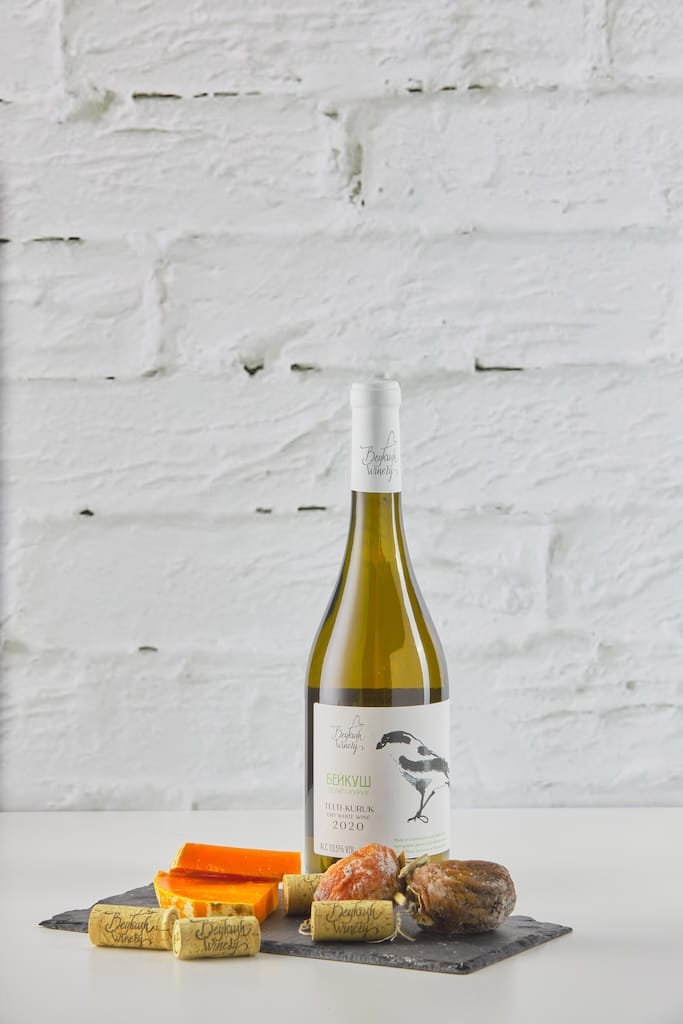
We harvest the grapes by hand at the end of September. After picking, the grapes undergo cold maceration for 12 hours at 4°C to reveal varietal aromatics without excessive phenolic extraction. The juice is fermented in stainless steel at a controlled temperature of 17°C — cool enough to preserve delicate aromatic compounds. The wine is then aged on fine lees with regular batonnage for five months. This extended lees aging adds body and textural complexity without overshadowing the authentic character of the variety.
Our taster describes Beykush Telti Kuruk as follows: “Behind white mulberry and quince hide bold lemongrass and white peaches. Freshness, agility, and a readiness to compete for its place at the table, closer to salads and fish.” International reviewers confirm this profile: The Grape Pursuit notes aromas of lemon, lime, pear, wet stone, nectarine, and beeswax, with high acidity and phenolic undertones. Three Drinkers named Beykush Telti-Kuruk one of the top 12 Ukrainian wines of 2024.
Our production volume is just over 2,000 bottles per year. This figure reflects both the rarity of the variety and our approach: better to make less and let the grape express itself fully.
Gastronomic potential and stylistic versatility of Telti-Kuruk
The versatility of Telti-Kuruk is one of its most underrated qualities. Xeniya Volosnikova compares it with Riesling, Chenin Blanc, and Chardonnay — varieties capable of producing everything from light sparkling wines to rich, barrel-aged whites. As a late-ripening grape, Telti-Kuruk can yield superb late-harvest and naturally semi-sweet wines. When harvested early, it is ideal as a base wine for sparkling. And for those who appreciate oak-aged whites, Telti-Kuruk, much like Chardonnay, shows a fine affinity for barrel aging.
Alcohol levels in Telti-Kuruk wines range from 11.5% to 13%, depending on the style and the winemaker’s intent. The wines typically display a medium to full body with a characteristic phenolic grip that lends structure — alongside a bright, vibrant acidity that maintains balance. Many tasters note a signature wild herb note that evokes the wind-swept steppes of the Black Sea coast.
When it comes to food pairings, the minerality and fresh acidity of Telti-Kuruk make it a natural partner for seafood — particularly fish, prawns, and shellfish. The wine works well with grilled vegetables, fresh salads, and soft cheeses. Pate is another successful pairing, where the wine’s waxy texture complements the richness of the dish. Reviewers at The Grape Pursuit also recommend Mediterranean dishes — grain bowls with roasted vegetables, where the wine reveals more peach notes.
Serving temperature: 10–12°C. This allows the aromatics to fully unfold while preserving the variety’s characteristic freshness and minerality.
Summary
Telti-Kuruk is a variety where botany meets history and agronomy meets geopolitics. Over five centuries, it has endured the Ottoman Empire, the Russian Empire, phylloxera, Soviet uprooting campaigns, and a full-scale war — and yet it remains rooted in this land. Its inclusion in the Slow Food Ark of Taste underscores what is already self-evident: this variety needs attention and preservation.
Today, only a handful of wineries in Ukraine work with Telti-Kuruk. The area under vine is measured in dozens of hectares, not thousands. Every bottle of wine from this grape is a fragment of the genetic code of the Northern Black Sea coast. Not a metaphor, but literal: the DNA of a vine shaped by this climate, these soils, the wind from the sea. For those who seek not only flavour but also meaning in their wine, Telti-Kuruk has a story to tell.